

Borovicanin v. NCAA Injunction Ruling: What It Means for Xavier
Understanding the Latest NCAA Legal Battle Over Player Eligibility

On Thursday afternoon, Hamilton County Common Pleas Judge Chris Wagner granted a preliminary injunction in the case of Borovicanin v. NCAA, temporarily restricting the NCAA from enforcing its revised interpretation of eligibility rules for Division I athletes whose collegiate careers included time at non-NCAA institutions.
The ruling offers additional eligibility to dozens of NCAA athletes who had filed a preliminary injunction on June 24th following the association’s adoption of a new “five-in-five” eligibility model earlier last month. The new NCAA policy replaces the longstanding framework of four seasons of competition within a five-year window with a simpler system: grant athletes up to five seasons of competition over five years, provided they enroll in college no later than the academic year after their 19th birthday. Wagner concluded that the plaintiffs demonstrated a likelihood of success on key aspects of their claims and would have suffered irreparable harm if they were forced to miss a season that could not be restored.
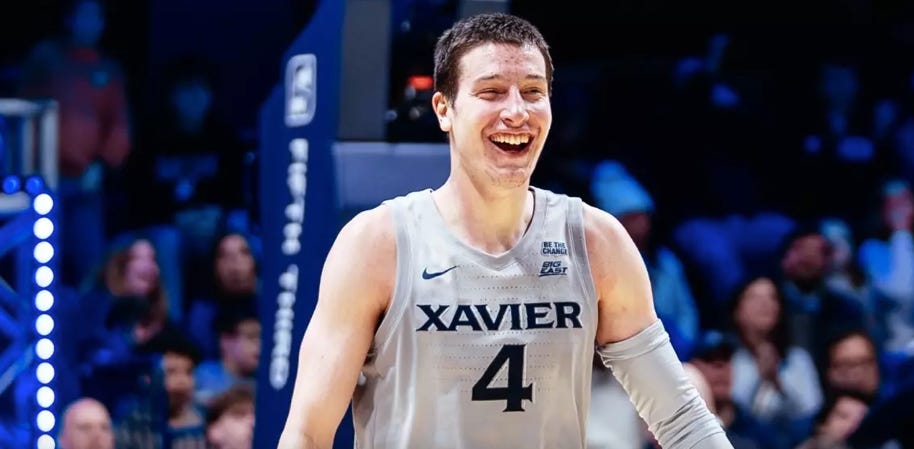
The namesake of the lead plaintiff is that of Filip Borovicanin, a Xavier forward who was born in Belgrade, Serbia, and is considered a class of 2022 high school graduate per United States stipulations.
Now, he’s eligible for a second season with the Musketeers — and the implications are sizable.
At the moment, Richard Pitino’s 2026-27 roster returns one of the Big East’s most unique and productive frontcourt players. While the NCAA has already announced its intention to appeal the ruling and seek a stay pending appeal, Thursday’s injunction gives Borovicanin — as well as dozens of similarly situated athletes — the opportunity to prepare for another collegiate season.
With that being said, the operative phrase is “at the moment.” The injunction itself is not a final ruling. Wagner’s court found that preserving the eligibility of athletes during ongoing legal proceedings best served public interest and opted to do so rather than enforce the NCAA’s revised rulebook before its legal questions are resolved. However, should the NCAA prevail upon appeal, Borovicanin’s eligibility could once again become uncertain before the next season tips off.
Still, for now, Xavier has its point-forward back. And that’s a huge win.
Borovicanin began his collegiate career at Arizona, appearing in 34 games across two seasons with the Wildcats from 2022-24 before transferring to New Mexico. There, he started 29 of 35 contests for a Lobos team that won the Mountain West Tournament and advanced to the second round of the 2025 March Madness field after defeating Marquette in the Round of 64.
His true breakout, however, came after following former New Mexico head coach Richard Pitino to Xavier ahead of the 2025-26 campaign.
Serving as the Musketeers’ starting center, Borovicanin blossomed into one of the conference’s most complete players, averaging 10.8 points, 7.4 rebounds, 4.2 assists and 1.2 steals per game while cracking the opening unit in 32 of Xavier’s 33 games. He also posted career highs in three-point percentage (34.9%) and free-throw percentage (87.3%) while shooting 43.3% from the field.
Those numbers only tell part of the story.
Few forwards nationally offered the combination of size and decision-making that Borovicanin brought to Xavier’s offense. His 139 assists ranked seventh in the Big East, and the aforementioned 4.2 assists per game ranked sixth in the conference. All of that came with an assist rate of 23.9% — ninth in the league, and just 59 giveaways all season, good for an outstanding 2.36 assist-to-turnover ratio.
Those are point guard-esque facilitative numbers. Borovicanin’s connectivity — his ability to initiate an offense, work through the pick-and-roll, operate from the high post, and stretch opposing big men beyond the three-point line — was a secret weapon for Xavier last year. It could come in handy once again, assuming he sees the floor.
Perhaps most impressively was how impactful Borovicanin was against conference foes, especially in a league known for its rough-and-tough attitude. Across 20 Big East starts, he averaged 11.4 points, 7.7 rebounds and 4.4 assists while knocking down 37.9% (25-of-66) of his three-point attempts on 3.3 attempts per game.
There aren’t many players in college basketball with such fluidity to their craft. Which is precisely why Thursday’s ruling carries such significance — not only for Xavier, but across Division I athletics.
At the center of the lawsuit is the NCAA’s revised interpretation of how seasons spent competing outside the NCAA count towards eligibility. The plaintiffs argue the NCAA abandoned its longstanding interpretation after athletes had already made enrollment decisions based on their previous understanding of the rules. Judge Wagner agreed that the plaintiffs demonstrated sufficient grounds to warrant temporary relief, hence the preliminary injunction in place while litigation continues.
Naturally, the NCAA was quick to push back. In a statement released via their public relations account (@NCAA_PR) to the social media platform X (formerly Twitter) in the wake of Thursday’s ruling, the association called the decision “wrong” and announced it would “immediately seek all avenues for reversal, including a stay of the court’s order pending appeal.”
The association argued that the ruling disregards longstanding precedent and permits unfair benefits to athletes who have already received the seasons of competition they expected. It also criticized member institutions that supported the litigation while renewing their call for congressional action to provide greater stability in college athletics. Also referenced by the defendants was the possibility of reduced opportunities for other student-athletes to participate.
The next legal steps matter. A successful motion for a stay could temporarily pause Thursday’s injunction while the appeal is heard, potentially placing the eligibility of Borovicanin et al. back into question before the season begins. And of course, the ultimate outcome of the lawsuit will determine whether Thursday’s decision becomes a permanent change or merely a temporary reprieve.
For now, though, the practical implications are straightforward: until the legal process says otherwise, all plaintiffs are eligible.
And for a Xavier program hoping to build on its first season under Richard Pitino, that’s a massive development.