

Connecticut Has a New Man in the Middle
Already one of the best shot blockers in the country as a freshman at Seton Hall, Najai Hines is now set to anchor UConn in the paint.

In March, the Connecticut Huskies fell just short of securing their seventh national title (and third in the last four seasons) when they lost to Michigan in the national title game, 69-63.
The No. 2 seed in the bracket’s East Region, UConn advanced to college basketball’s final evening by way of a tremendous NCAA Tournament run, during which standout senior Tarris Reed Jr. averaged 19.5 points and 13.2 rebounds per game.
His March Madness résumé included a 31-point, 27-board explosion in the first round versus Furman, as well as two additional twenty-point performances (20 points and 5 rebounds versus Michigan State in the Sweet 16; 26 points, 9 boards, and 4 blocks against Duke in the Elite Eight).
Reed dominated the 2026 Tournament before facing a Wolverines team ranked 27th in average height — one featuring three outstanding bigs in their starting lineup (the 6’9” Yaxel Landeborg, 6’10” Morez Johnson Jr., and the monstrous 7’3” Aday Mara).
A man who played for Michigan from 2022-24, Reed struggled with his old team’s size in the finale, but regardless he revived his career under Dan Hurley — earning 1st Team All-Big East honors, winning Most Outstanding Player of the East Region, and he’s now being talked about as the next UConn center to go in the first round of the NBA Draft.
A Changing of the Guard at Center
Reed’s departure left the Huskies with a clear void entering the 2026-27 season. In theory, his role would have been filled by the 7’1” rising sophomore Eric Reibe, a former five-star recruit who spent much of the 2025-26 league year as the backup big man in Connecticut’s frontcourt — where he’d prove to be reliable, averaging 5.9 points and 3.3 rebounds per game on 65.8% shooting, including a Big East-best 69% (100-for-145) from two-point range, while appearing in an NCAA-best 40 games. However, Reibe transferred to USC earlier this offseason, further intensifying UConn’s need for an established frontcourt presence.
All it took to find their next great center was a quick trip down I-95.
Enter Najai Hines.
A 6’10”, 265-pound former four-star recruit, Hines fits the mold of a “thumper,” with a rugged play style which Big East traditionalists have come to love. The Plainfield, New Jersey native stayed local for his freshman season, serving as the defensive anchor of a Seton Hall unit which ranked 15th nationally in points allowed per 100 possessions.
Despite failing to crack the Pirates’ opening unit in any of his 31 games played last year (and only averaging 18 minutes per contest), Hines made a substantial impact on the floor:
He averaged 6.5 points, 5.5 rebounds, and a conference-best 2.2 blocks per game on 60.2% shooting (80-for-133)
His 69 total blocks on the year were tied with Reed for the third most in the Big East, behind only Providence’s Oswin Erhunmwunse (70) and Saint John’s star Zuby Ejiofor (79).
Anyone familiar with Seton Hall head coach Shaheen Holloway’s defensive philosophy understands that it begins with stout rim protection:
Opponents looking to press the paint versus the Pirates did so to little avail this year, as they shot 46.4% from the interior (17th nationally).
Furthermore, the Hall maintained the nation’s best blocked shot rate of 18.7% — a mark 1.3 percentage points ahead of second-place Virginia (17.4%) and near double the national average of 9.5%.
While the collective structure around him helped, Hines was an integral component of Seton Hall’s defensive success. His Block Rate of 16.4% was second in all of Division I play (trailing only Virginia’s Ugonna Onyenso at 17.4%), and he showed excellent defensive discipline, evidenced by a blocks-to-foul ratio of 0.95 (69 rejections against 73 personal fouls last year) which ranked in the 98th percentile nationally.
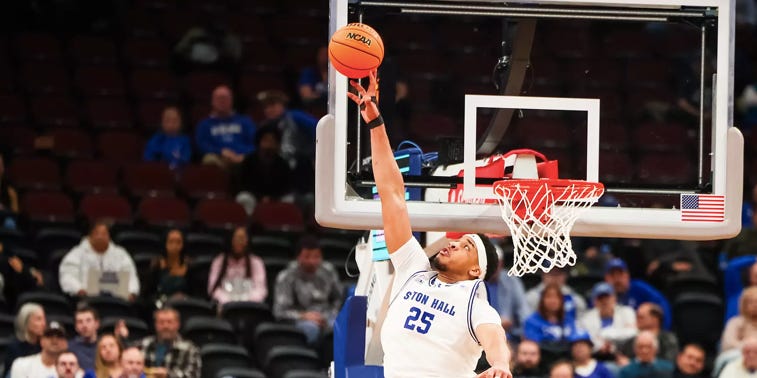
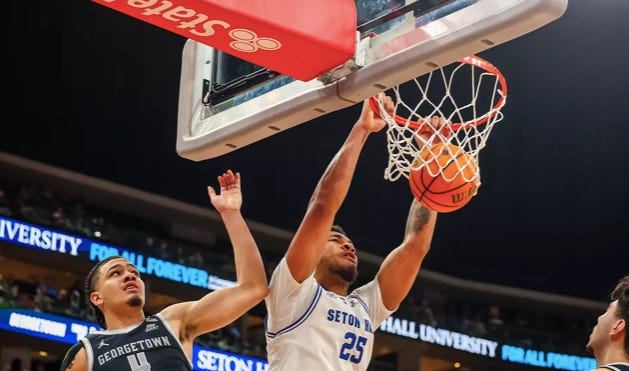
Here’s just a sampling of his terrific shot-blocking ability:
Where Does His Offense Come From?
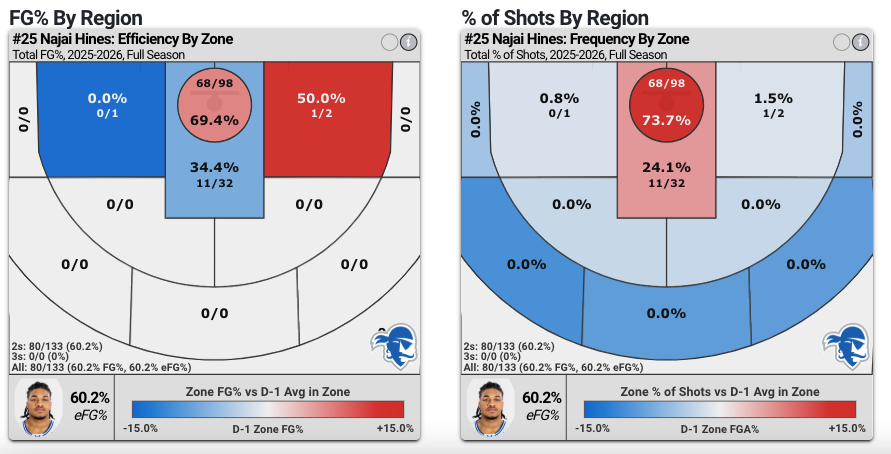
Hines reflects the conventional back-to-the-basket big. He thrives inside, with virtually all of his offense coming in the paint. At Seton Hall, he operated in a relatively low-usage role offensively (16.8%; 45th percentile) but was indispensable in both generating secondary scoring opportunities, thanks to his excellent offensive rebounding (15.5%; 97th percentile), and second-chance scoring, which accounted for 30.5% of his total offensive production (86th percentile).
Whether or not there will be greater usage for him in a Connecticut system loaded with high-end talent across the board remains to be seen, but recent history suggests he could have strong involvement. Last year, Reed posted a 26% usage rate (93rd percentile), while Reibe maintained a solid 19.1% mark (62nd percentile) in his reserve role.
Let’s take a look at Hines offensively, where he buries smaller defenders when posting up, hits the offensive glass hard, and finishes well as a roll man:
Stepping into a Massive Void
Hines comes to Storrs with big shoes to fill. In 2025-26, Reed led the Big East in Player Efficiency Rating (28.8) and Defensive Rating (92.9). He also finishing atop the conference leaderboard in two-point field goals (210), both Field Goal/Effective Field Goal Percentage (60.7%), and Defensive Box Plus/Minus (6.1), while splitting first with Zuby Ejiofor in Defensive Win Shares (2.6).
Despite his upside, expecting Hines to immediately replicate that level of production would be unreasonable. The learning curve playing for Hurley is steep, and Reed certainly had his adjustment coming in from Michigan.
However, Reed’s successor impacts winning in so many ways. Hines’ statistical profile at Seton Hall strongly suggest he has all of the tools needed to elevate Connecticut’s defense while also enhancing his own offensive ceiling — especially given he’ll be able to run pick-and-rolls with Silas Demary Jr., who averaged a Big East-best 5.9 assists per game last season.
This is why the move feels like a perfect marriage between player and program. Connecticut needed to incorporate more size and physicality to their rotation, and when Hines entered the portal, the match became a no-brainer.
His new destination ultimately keeps him close to home, within the conference, and positions him as the likely starting center for a Huskies team expected to open the year inside the top five of the AP preseason poll, as well as firmly within the national championship conversation once again.
And with the improvement of Reed, Donovan Clingan, and Adama Sanogo in recent years, there’s no reason to believe Hines won’t turn into one of the best big men in the country in time, following a promising freshman campaign.
Hines’ commitment serves as another reminder that UConn’s sustained dominance (both under Hurley and throughout the 21st century) has been driven as much by roster construction as it has on-court execution. The program has consistently adapted to the increasingly volatile landscape of modern college basketball, and this addition is just another one of their championship-level responses.
Enjoying what you’ve seen from The Big East Film Room so far? Help us continue to grow by spreading the word to your network! We’re committed to providing insightful, unbiased, in-depth, and year-round coverage of the Big East.
If you haven’t already done so, please consider becoming a subscriber to help us bring even more great coverage of the league.