

Five Big East Players Selected in 2026 NBA Draft
The conference once again proved itself to be one of college basketball's premier pipelines to the professional ranks.

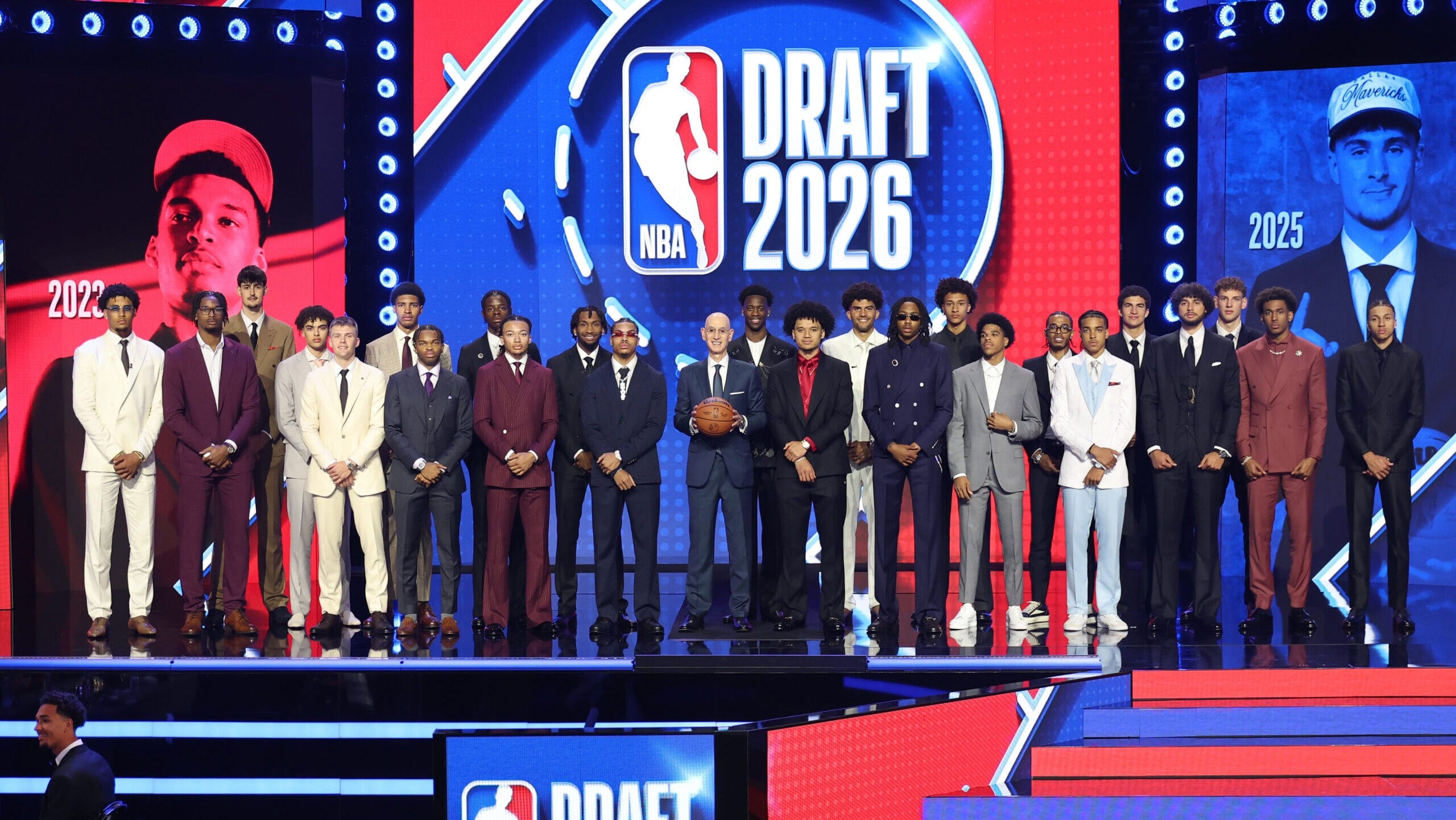
For two nights this week, all eyes in the basketball world turned to the Barclays Center in Brooklyn as the 2026 NBA Draft unfolded on June 23-24. As the next generation of NBA talent heard their names called, the Big East once again reaffirmed its place among college basketball’s premier conferences, producing five draft selections across the two-round event, with three first-round picks.
All five players were seniors who capped off decorated collegiate careers, and each resembled the toughness and winning pedigree seemingly synonymous with Big East basketball. Here’s a look at the league alumni who were drafted, where they landed, and what each brings to the next level:
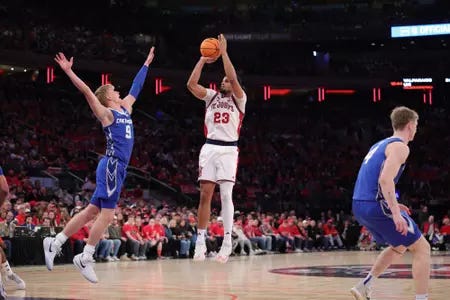
Zuby Ejiofor, F, St. John’s
Drafted: Round 1, Pick No. 23 by the Atlanta Hawks
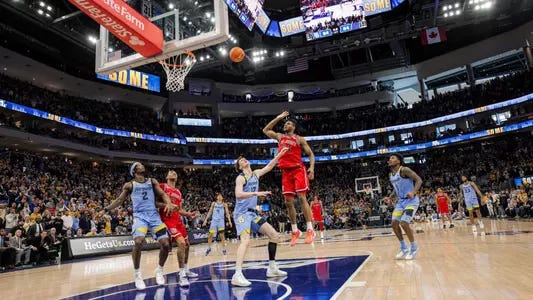
Following a freshman campaign at Kansas in which he averaged just 5.1 minutes per game across 25 appearances, Zuby Ejiofor transferred to St. John’s in search of a larger role. The result: a development into one of college basketball’s most complete and productive frontcourt players over the past three seasons. Ejiofor’s developmental leap blossomed into stardom under Rick Pitino, with the forward steadily improving year-to-year as a scorer, defender, and connective piece within a physical, winning system.
In 2025-26, Ejiofor had fully broken out as one of the best players in all the land. He averaged 16.3 points, 7.3 rebounds, 3.5 assists, and 2.1 blocks per game while shooting 53.6% from the field, earning Big East Player of the Year, Defensive Player of the Year, and All-Big East honors while anchoring a deep St. John’s team that reached the Sweet 16. Across his St. John’s career, he finished as a multi-year All-Big East selection and one of the most statistically versatile bigs in the country, impacting games as a scorer, rebounder, passer, and rim protector, while also added improved perimeter defense on an annual basis
For Atlanta, Ejiofor gels nicely with a rising roster coming off a season in which the Hawks pushed the eventual champion Knicks to six games in the first round of the playoffs (they also held a 2-1 series lead before dropping three in a row). Their elimination proved a need more frontcourt depth and versatility within their rotation, and Ejiofor brings exactly that: a high-motor, multi-positional frontcourt defender who can rebound, protect the rim, and make quick decisions on the floor. While he lacks ideal size for a traditional NBA center, his strength, motor, and 7’2” wingspan give him real small-ball five potential. For a Hawks system that values versatility, it’s great to add an immediate rotation piece whose impact should translate quickly.
Tarris Reed, F, Connecticut
Drafted: Round 1, Pick No. 26 by the Denver Nuggets (rights traded to the San Antonio Spurs)
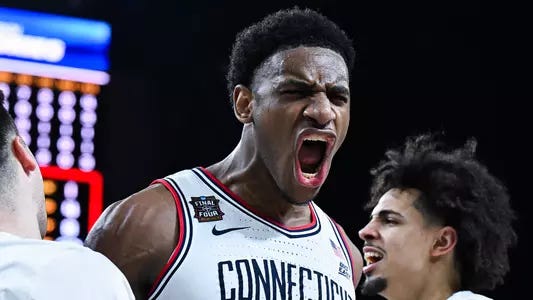
Reed’s path to the NBA has been a steady climb built on his own evolution. The forward began his college career at Michigan, where over two seasons in Ann Arbor, he showed flashes of what would become his identity: physical finishing around the rim, solid rebounding, and shot-blocking intangibles- before transferring to UConn in search of a larger role and a winning environment.
It was a move which paid massive dividends. Reed finished his college career with 136 total games played, averaging 9.2 points, 6.8 rebounds, and 1.5 blocks per game on an extremely efficient 59.1% shooting from the field- but in his two seasons with the Huskies, he elevated his game entirely. Across 70 games (36 starts) in Storrs from 2024-26, he became a key piece in one of the nation’s most consistent programs, averaging 12.2 points, 8.1 rebounds, 1.7 assists, and 1.8 rejections, earning Big East Sixth Man of the Year honors in 2024-25 before capping his career with First Team All-Big East and NCAA All-Tournament recognition in his final season.
Reed represents a vital addition to the San Antonio frontcourt. Fresh off their NBA Finals appearance, the Spurs entered this offseason in need of more reliable depth behind Victor Wembanyama, where the bench unit often lacked a consistent interior presence. Luke Kornet had uneven impact in the backup center role, while veterans like Bismack Biyombo, Kelly Olynyk, and Mason Plumlee, being back-end veterans, were used sparingly. Reed was the second big taken by the reigning Western Conference champions in the first round of the draft (Kentucky’s Jayden Quaintance was first with the twentieth overall pick), but Quaintance is likely to redshirt his true rookie season as he’ll require knee surgery, which means the door is wide open for Reed to contribute immediately. In that context, the ex-Connecticut product projects as a ready-made rotation big who can rebound, score on the low block, set solid screens, and be virtually immovable defensively — all of which are traits that should translate quickly in the Spurs’ young, win-now environment.
Alex Karaban, F, Connecticut
Drafted: Round 1, Pick No. 29 by the Cleveland Cavaliers (rights traded to the Sacramento Kings)
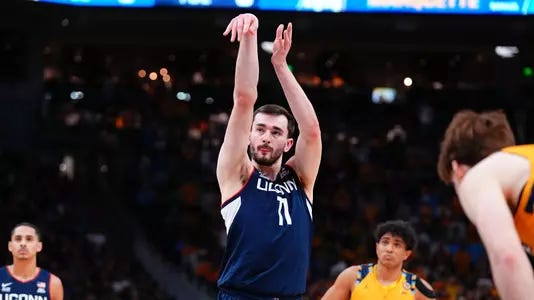
Things seemed to be going well in Sacramento in 2022-23, when they posted a 48-34 mark, winning the Western Conference’s Pacific Division for the first time since 2002-03 and making their first playoff appearance since 2006. However, as has been the case throughout the franchise’s history, they haven’t done a lot of winning in recent memory, especially over the last three seasons, where they’ve gone 108-140 (including a 22-60 record this past year).
Why not bring in the ultimate winner to counteract that? Across his four years in Storrs, Karaban built one of the most decorated résumés in college basketball, finishing with a program-record 126 wins against just 25 losses while helping lead Connecticut to back-to-back NCAA Championships in 2023 and 2024, and earned back-to-back All-Big East selections (Second Team in 2024-25; First Team in 2025-26). Karaban appeared in 151 career games (with 150 starts) and missed just three contests over four seasons with the Huskies. He closed his college career as a 1,880-point scorer with 758 rebounds, 309 assists, and 145 blocks, as well as the program’s all-time leader in three-pointers made (292) on high volume (780 career attempts; 37.4% 3PT).
From a statistical standpoint, Karaban is a tremendous value add. The 6’8”, 210-pound forward is a prototypical NBA wing, evident by his career scoring average of 12.5 PPG on 46.8% shooting overall. He’s also a sneaky good rebounder (5 per game for his career), improved as a facilitator as an upperclassman, doling out 186 assists to just 86 turnovers the past two seasons (an AST:TO ratio of a respectable 2.16), and can hold his own defensively. Sacramento’s youth movement needs a player on the wing that can stabilize the group, and Karaban’s collegiate successes make him as much of a veteran-style player as you’ll find in this class.
Dillon Mitchell, F. St. John’s
Drafted: Round 2, Pick No. 40 by the Boston Celtics
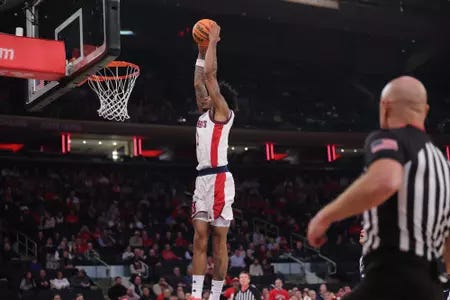
For a team whose two best players (at least, if the roster stays together) are a pair of wings in Jayson Tatum and Jaylen Brown, Boston sure knows how to pick them. So, it should come as no surprise that the Celtics took a flyer on Mitchell, a former five-star recruit who’s shooting never quite developed at the collegiate level (he finished his career just 11-for-57 from three and was 1-for-15 from beyond the arc in 2025-26).
Mitchell spent his underclassman years at Texas, where he started 71 of his 72 games played for the Longhorns, establishing himself as one of the better defensive forwards in the Big 12 before transferring to Cincinnati for the 2024-25 campaign, and eventually finishing his collegiate career at St. John’s. This past year for the Red Storm, Mitchell embraced a sort of do-it-all complementary role on a veteran, winning roster, averaging eight points, seven rebounds, and three assists per game (with 25 starts across 37 games) as he helped the Red Storm reach the Sweet 16 while showcasing the defensive versatility and energy that made him such a coveted recruit coming out of high school.
What Mitchell lacks as a shooter, he makes up for with elite athleticism, defensive versatility, and a relentless motor. He thrives as a cutter, is quick in transition, and can jump out of the gym. Pitino heavily relied on Mitchell as this past season progressed, often utilizing him as a de-facto point guard (3.5 assists per contest in Big East play) and an oversized defender on the perimeter (1.3 steals per game). For Boston, the fit is fairly straightforward. The Celtics have built their identity around position-less basketball — Mitchell, of course, is the definition of such. His current offensive limitations might be fixable by Boston’s development team, but his greatest value at the next level will be his defensive versatility, rebounding efficiency, and ability to generate extra possessions. At No. 40 overall, it’s a sensible flyer being taken on a player fully capable of outperforming his draft slot.
Bryce Hopkins, F, St. John’s
Drafted: Round 2, Pick No. 49 by the Denver Nuggets
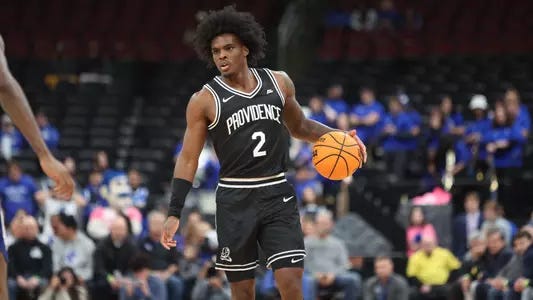
Hopkins has had quite the journey to hearing his name called on Wednesday night. A top recruit in the 2021 high school class, He initially attended the University of Kentucky, where he struggled to see the floor in 2021-22, and transferred to Providence College at season’s end. Hopkins immediately broke out for the Friars, averaging 15.8 points and 8.5 rebounds in 2022-23 while earning First Team All-Big East honors, but a torn ACL in January 2024 and subsequent knee issues thereafter limited him to just 17 games over the following two seasons.
After entering this past year with legitimate questions about whether he still had NBA potential, Hopkins’ revived his stock at St. John’s in 2025-26, starting all 37 games and earning Second-Team All-Big East honors for a Red Storm group which reached the Sweet 16. He registered 13.6 points, 6.2 rebounds, and 1.9 assists per game on 46.9% from the field and 36.3% from three while proving to NBA suitors that he could stay healthy, accept a complementary role on a winning team, and operate within Rick Pitino’s uber-big system, oftentimes sharing the floor with both Ejiofor and Mitchell.
It’s a reasonable, upside-based swing for Denver. The Nuggets’ second unit could benefit from a physical, shot-creating forward, and Hopkins’ rebounding, physicality, and scoring capabilities are comparable to those who have historically thrived next to star forward Nikola Jokić. The concern, sans the knee issue, is that Hopkins is somewhat undersized for an NBA power forward with some work to do before he’s a consistent floor spacer. Even still, he’s an offensive-minded energy wing, who, at pick 49, has justifiable value given the talent level is closer to that of a late first-round prospect than a typical late-second rounder.
In addition to its five draftees, the Big East also saw several players quickly earn NBA opportunities as undrafted free agents:
Michael Ajayi, Forward, Butler: Charlotte Hornets (Two-Way Contract)
Duke Brennan, Forward, Villanova: Brooklyn Nets (Summer League Contract)
Jaylin Sellers, Guard, Providence: Chicago Bulls (Two-Way Contract)
Chase Ross, Guard, Marquette: Los Angeles Lakers (Exhibit 10 Contract)
Josh Dix, Guard, Creighton: Oklahoma City Thunder (Two-Way Contract)
Whether through hearing their name called on Tuesday/ Wednesday or in being signed afterwards, the 2026 NBA Draft cycle once again demonstrated the Big East’s ability to develop NBA-caliber talent, with players from across the conference taking the next step in their basketball journeys.