

Pumping the Brakes on NJ Benson and Brody Robinson During “Great Get” Season
The impressive numbers come with legitimate question marks for the latest portal additions to the Big East.

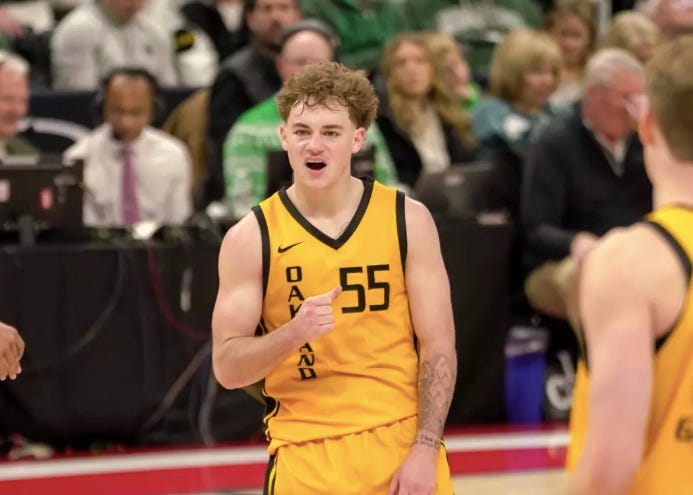
On paper, it’s hard not to be enthusiastic about what Creighton and Georgetown accomplished in the transfer portal’s 17th hour.
The Jays picked up Oakland transfer Brody Robinson, an All-Horizon First Team point guard who averaged 17.6 points and 6.7 assists per game last season. Robinson closed his season with a 36-point effort against Western Kentucky in the Horizon Tournament, had 11 games of 20+ points, and five others with 10+ assists.
The 5’11 guard figures to give Alan Huss more versatility in the backcourt, joining a rebuilt guard rotation that includes USF scorer/transfer Wes Enis and a tough defensive guard in BJ Davis (notably, also a guard who brings experience starting and coming off the bench at San Diego State).
Then there’s NJ Benson, the DePaul transfer who (like Robinson) was granted a fifth year of eligibility this week in the never-ending transfer portal season of 2026.
Georgetown fans were downright giddy to add the 6’8 center who averaged 11.7 points and 7.6 rebounds per game for a DePaul club that has continued to climb defensively under Chris Holtmann. The Blue Demons were 315th in the country defensively two years ago, and saw that ranking jump to 139th in 2025 and then all the way up to 32nd last year.
While undersized at center, Benson serves as a significant upgrade from both a veteran and physicality perspective for the Hoyas, who really only had one true big on their roster — and a slight one at that — in the sub-200 pound seven-footer Chol Machot (who transferred in from Charleston).
Benson was one of the best rebounders in the Big East last season (22.8% Defensive Rebound Percentage/93rd Percentile) and finished the regular season with more dunks than any other player in the country.
And while this is “great get” season and I’m certain to hear about it the next time Benson goes for 10 points and 16 boards against Marquette or 24/10/3 versus Butler (like he did last season), I’m pumping the brakes before labeling either of these players the difference between being an NCAA Tournament team or not.
How NJ Benson got his buckets last season and the translation to Georgetown
Benson’s numbers at DePaul last season were very good. This a big man who shot 63% from the field and had a number of big nights as a senior — the two games mentioned above, as well as 19 points and 10 boards versus Providence, 23 and 10 against Creighton, a 16-rebound effort against Georgetown, and so on.
And while the sheer number of dunks Benson had was impressive (he closed the season with the fifth most in the country behind a list including Somto Cyril, Flory Bidunga, Aday Mara, and Izaiyah Nelson) — how does that translate from DePaul to Georgetown?
Under Holtmann, the Demons were, far and away, the biggest alley-oop threat in the Big East last season. The top three in terms of lobs?
DePaul: 59
Providence: 38
Creighton: 23
Georgetown finished the season with 16 alley oops.
Benson alone had 40 lob dunks, more than any other team in the league.
His 79 total dunks were 24 more than Jamier Jones of Providence, who had the second most in the league in 2026.
Is Benson simply a supreme lob threat or a product of a system that got him countless looks above the rim?
We’re about to find out.
Georgetown will have a different look at point guard next year, assuming Jaland Lowe returns to form after shoulder injuries all but cost him the entire year at Kentucky. Lowe averaged nearly 17 points and 5.5 assists per game two seasons ago at Pittsburgh, and he’ll be critical in ensuring that Benson continues getting looks at the rim.
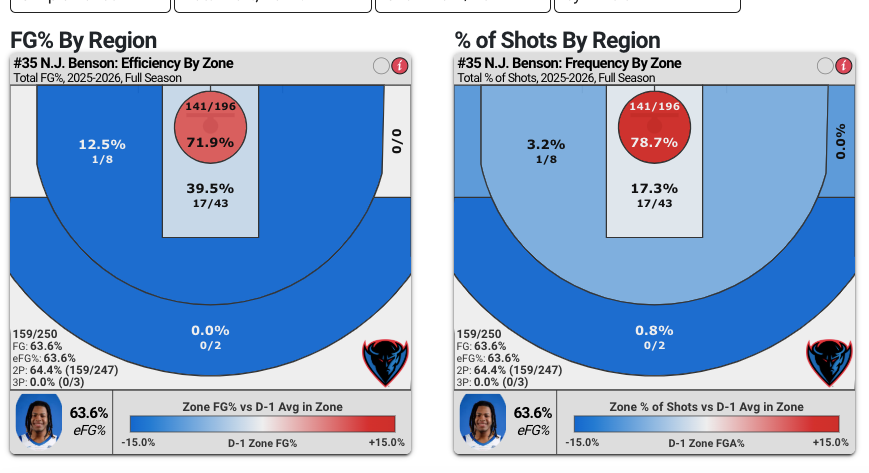
Benson’s offensive game has been limited to makes at the rim through four seasons, however. He was 1-11 from three across two seasons at DePaul, made 8-21 on hook shots last season, and rarely looked to take mid-range jumpers.
Defensively, he logged 26 minutes per game for a top-40 club, and while he’d been good for a block-and-a-half a game for much of his career, Benson blocked just 25 shots in 32 games last season (0.8 per game), while also coming up with 14 steals (0.4).
Undoubtedly, the addition of Benson is a significant upgrade for Georgetown, but what they do next will likely determine just how impactful it is.
Benson won’t stretch the floor, so he’s a five-man offensively, and it’ll be interesting to see if Ed Cooley and his staff add another big (Cooley hinted at adding a European or hoping that Vince Iwuchukwu gets cleared at a recent press conference).
The center spot would get crowded with Benson, Machot, and another five, so it might make the most sense for them to add a European prospect with 4/5 versatility — and bring Machot off the bench as a shot-blocking difference maker.
It’s notable that Holtmann made a concerted effort to get longer at the five spot in the portal this year, while it’ll be worth tracking how much damage Benson does at the rim away from the lob-heavy attack of DePaul.
Unpacking Brody Robinson
Seventeen points and nearly seven assists per game doesn’t happen by accident. The well-traveled Robinson found a home at Oakland last year after a career that led him from Chattanooga to Garden City CC, UT-Arlington, and finally Oakland.
Robinson is a career 38% 3-point shooter who flashed some very good passing ability — even against the likes of Michigan and Houston. Here’s an extended look at him against those elite defenses last November. It was a bit of a mixed bag, but there are some great looks included.
There’s a lot to like offensively here: 41% as a spot-up shooter, quick release, did a lot of damage on pull-up jumpers, possesses a tough step-back jumper, and a 2.7-to-1 assist-to-turnover ratio.
He had some massive statistical nights in the Horizon, and even went for 13 and eight against Michigan State. Plus, he got to the free throw line a ton, despite his size.
Unlike with Benson, any question marks that pertain to Robinson’s game are alleviated a bit because he’s supplementing the rotation. A Robinson/Davis point guard pairing gives Alan Huss two pretty distinct looks — Robinson is an offensive dynamo, while Davis is a product of one of the best defensive programs in the country at San Diego State.
The key question for Robinson will be his size (he’s listed at 5’11, 160 pounds). His handle got a bit loose at times in the games I watched, and he struggled early when facing Michigan, Houston, and Purdue to kick off last year (7-26 from the field, 5-16 from 3). His numbers at the rim weren’t great either.
Defensively, he could face real challenges. Oakland ranked 293rd in Defensive Efficiency in 2026, while CBB Analytics had Robinson in the 16th percentile in their DRAPM metric.
Regardless, the addition of Robinson at this late stage feels like a risk-free swing at a veteran who has put up big offensive numbers. He can share the lead guard spot with Davis, or play alongside him in smaller lineups.
So while there’s a lot to like about both the Robinson and Benson signings, in this extended “great get” season there are critical questions facing both players beyond the impressive scoring, assist, and rebounding averages.